Pelee Episode IV - Revenge of the Grosbeak


    On the morning of May 10th I woke up at 5am and headed to the tip of Point Pelee with high hopes. For the last few days I had been watching different models and forecasts, which showed ideal conditions for the morning of the 10th. On the night of the 9th there were strong southwest winds reaching all the way from the gulf coast and clear skies that allowed a large number of birds to surge north on the warm air. In the morning the wind at surface level was still out of the southwest, but was fairly light.. another good sign. I was hoping for more than a general increase of birds that comes with weather like this though, I wanted a good reverse migration at the tip too. Reverse migration, reorientation flight, morning flight... there are several different words that describe this phenomena, but call it what you will it's my favourite thing at Point Pelee. During specific conditions (generally southwest wind in the morning after a strong night of migration) hundreds or even thousands of songbirds can be seen flying south off the tip of the point and heading over Lake Erie back towards Pelee Island and Ohio. There are several theories as to why this happens, and the truth is likely a mash up of all of them. Some of these birds are "overshoots" that get caught up in the strong tailwinds and migrate too far north, and then they try to correct for their error and return south. Others are doing some kind of reorientation flight, and will fly over the point and disappear to the south, only to loop back and repeat this again.,, which could be a way of helping to realign their mental compass... anyways I'm not going down that rabbit hole now!

On the walk out that morning there was just a feeling in the air, and my excitment built and built as I neared the point, the first hues of light starting to appear on the horizon. Even at this early hour it was evident that things were happening, as warblers and orioles were calling and flying overhead. There were lots of faint chip notes too, made by unseen birds that were flying higher up than I could see, lost in the predawn darkness. As the morning progressed the crush on the point intensified, as over 100 birders clustered on the small spit of sand and rocks for the best viewing positions. I spent the morning there with the epic crew of Skevington, Wilcox, Konze and Campanelli, at the prime spot by the edge of the point. Often the reverse doesn't start getting good until 7am, but this day was clearly different. It wasn't even 6:20am and we had already had close to 200 Baltimore Orioles and a large number of warblers.

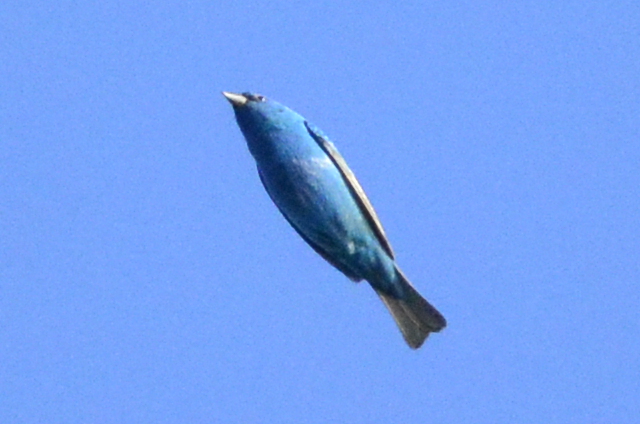
Then the first big highlight of the morning came, when a large brownish songbird with a thick bill and a long tail flew overhead, a young male Blue Grosbeak! It flew over our heads, then circled back down the edge of the point, never to be seen again. This was a lifer for me, and also one of my main Pelee targets for May. That was followed by a male Dickcissel, my first one of the year and always a fun bird to see flying over.

In the end I spent close to 5 hours at the tip before moving on for the day... the birding was just that good! I tallied 82 species at the tip, with some totals below (first of year birds in bold):

- 8 Red-headed Woodpeckers

- 1 Blue-headed Vireo

- 1 Philadelphia Vireo

- 4 Red-eyed Vireos

- 32 Warbling Vireos

- 4 Great Crested Flycatchers

- 15 Eastern Kingbirds

- 1 Eastern Wood-pewee

- 1 Swainson's Thrush (rarely seen in reverse)

- 1 Purple Finch

- 1 Eastern Meadowlark

- 35 Orchard Orioles

- 600 Baltimore Orioles

- 3 Blue-winged Warblers

- 14 Black-and-white Warblers

- 5 Tennessee Warblers

- 12 Nashville Warblers

- 5 Cape May Warblers

- 3 Bay-breasted Warblers

- 3 Magnolia Warblers

- 25 Blackburnian Warblers

- 13 Northern Parulas

- 30 Chestnut-sided Warblers

- 350 Yellow Warblers

- 1 Black-throated Blue Warbler

- 14 Black-throated Green Warblers

- 28 Scarlet Tanagers

- 15 Rose-breasted Grosbeaks

- 1 Blue Grosbeak

- 110 Indigo Buntings

- 1 Dickcissel

- 300 warbler sp (too far to ID)

- 2,613 birds total


It truly was a fantastic morning, definitely one of my highlights of the spring. Some photos below...


- Scarlet Tanagers

- Dickcissel

- Dickcissel

- Baltimore Oriole

- Baltimore Oriole

- Orchard Oriole

- Red-eyed Vireo

- Red-headed Woodpecker

- Same bird

- Philadelphia Vireo

- Indigo Bunting

- Scarlet Tanager

- Swainson's Thrush

- Blue Grosbeak!

- Blue Grosbeak

The rest of the day at Pelee I spent birding with William Konze and Alessandra Wilcox, walking most of the trails in the park. It became evident fairly quickly that the majority of the birds had just passed over or had revered back to Ohio, as numbers in the forests weren't that high. We did have some highlights though, including 2 Golden-winged Warblers, 2 Blue-winged Warblers, 4 Prothonotary Warblers, 1 Yellow-throated Vireo and my first Pelee Eastern Screech-owl.

- Prothonotary Warbler 

- Scarlet Tanager with some weird yellow patches

- Eastern Screech-owl

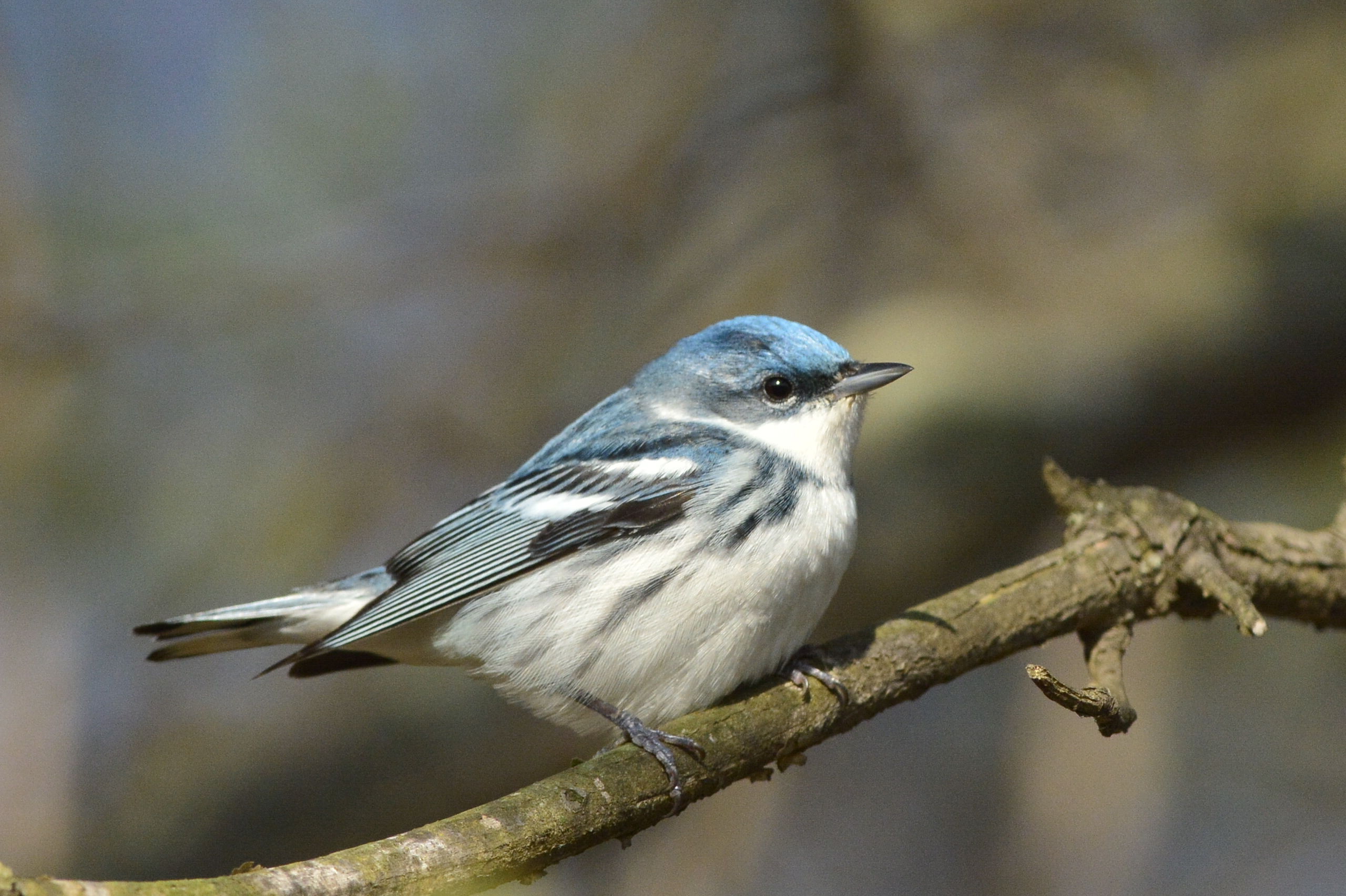
In the evening we were just headed into Leamington to get dinner when a report came in off a possible Plumbeous Vireo that had been photographed at Kopegaron Woods near Wheatley. There have only been two records of this species in Ontario before, and we got over there in a flash! Kopegaron turned out to be a small forest lot that was surrounded on all sides by agricultural land. An interesting spot for such a rarity to turn up at. There were already a few birders present when we arrived, with more trickling in as time went on. It should have been a relatively easy chase, as one would think that a bird like that would remain in a small woodlot for the day. But despite a two hour search, we came up empty. It wasn't a total bust though... As the sun was starting to set the west edge of the forest was illuminated by the warm glow of evening light, while the rest of the forest was shrouded in darkness. This meant that foraging songbirds were drawn to the sunny area to get their last feeding of the night in. For an hour I enjoyed what had to be some of my best views of warblers all spring, including a breathtaking male Cerulean Warbler only a few feet away. This was a yearbird too, and I can't imagine a better way of seeing one.

- Black-throated Blue Warbler

- Black-throated Green Warbler

- Cerulean Warbler


- Magnolia Warbler

Back with more soon!

Ontario yearlist @ May 10th - 293

Pelee Episode III - The Phantom Tanager


  I'll start off by just saying yikes... It has been so long since my last update. After keeping up with fairly regular posts all year, I got overwhelmed in early May and blogging just didn't happen. For almost the entirety of May I was staying in Camp Henry, the small campground located just north of the visitor center at Point Pelee. While there were many advantages of staying there, such as the cheap price and not having to drive to the park each morning... there were a few things that were not so ideal, with the main one being that there was no wifi and also no cell service in the campground. Normally I wouldn't mind this type of thing on a trip, but from a big year point of view (receiving alerts and doing anything on my computer) it was fairly annoying. Also we had a lot of visitors throughout the month, meaning that at the end of the day there was very little free time! Anyways there are my excuses!

I'm back home now, finally, after a whirlwind of a month down in southwestern Ontario. In the next week or so I will be trying to catch up on my blog and bring everyone up to date on my year, The idea is to do a post covering every week or so, with a few other random things in there!

My last update covered until the afternoon of May 5th, when I saw a White-faced Ibis at Hillman Marsh, so to keep the timeline from getting confusing I will start off there. 


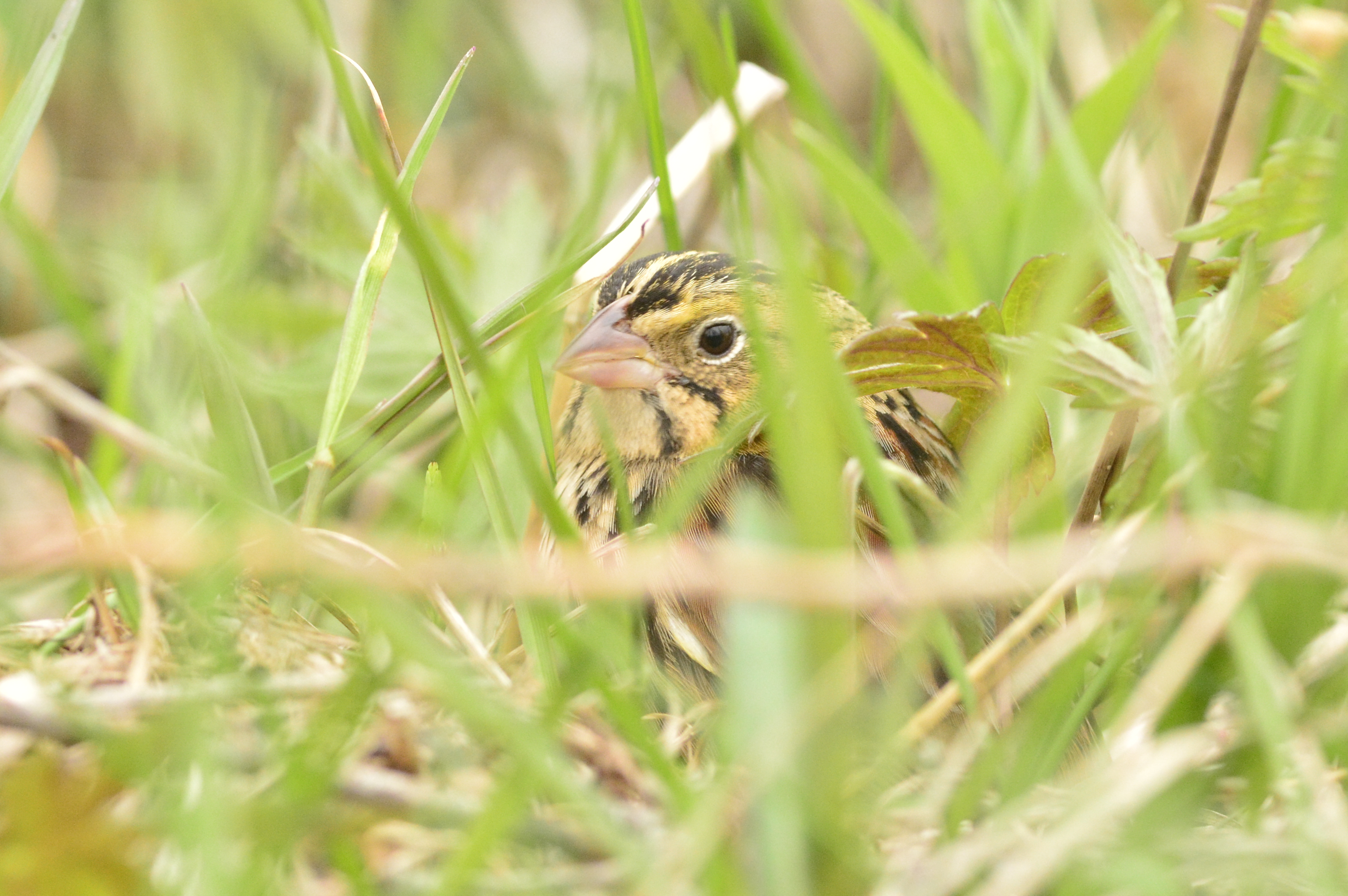
May 6th was a fairly quiet one in the park, with wind from the north and a limited number of new arrivals. A Henslow's Sparrow report came in from Rondeau though, so that made up for the poor morning. I promptly headed over there with Ezra, Eric Baldo and William Konze, getting there just over an hour later. We parked at the Marsh Trail lot and walked the remaining 500 meters up to where the bird had been seen. Other people were there when we arrived and pointed up to the grass just ahead of them. Sure enough there was a small sparrow there, slinking around in the grass like a vole. We enjoyed watching it for over half an hour, during which time it basically stayed hidden in the grasses. Then just as we were about to leave it hopped right out in the path in front me me, giving our small group eye melting views. Henslow's Sparrow is an OBRC review species and can be a tough bird to get in Ontario, so this was a nice treat.
- Henslow's Sparrow


The following day (May 8th) was fairly similar at Pelee... more north winds and not a lot of new migrants.  There weren't many highlights besides seeing the Worm-eating Warbler for a 2nd time.

- Worm-eating stakeout


 I only birded for a few hours in the morning, as due to my ongoing car issues I had to go back to Bruce and borrow my parents car for a week. Mine was being repaired in Leamington but it was going to take a few days, and with May being the big time for rarities showing up I couldn't be without a car! Luckily some Bruce Birding Club folk (Ralph and Mary-ann Knowles) were heading home to Bruce from Pelee and had generously offered to take me with them. In a way it was good that Pelee wasn't too productive, as it made me feel like I wasn't missing out on much!

After 4 hours of driving we were back in Kincardine, were my parents had driven their car down for me (much appreciated!). I was just about to begin the long drive back to Pelee when I got a notification that Ryan Griffiths had just found a Black-headed Gull at the Queenston docks in Niagara. This was over an hour closer than driving to Pelee, plus Black-headed Gull is a good rarity to get out of the way on a big year, so I started heading east. My first stop was at the docks where the bird had been found, as sometimes gulls spend the whole day circling there. There were a decent number of Bonaparte's Gull catching insects over the river, but they were actually outnumbered by Common Terns, not a bird I'm really used to seeing in such massive numbers. Just before I left a Black Vulture flew over my head and crossed the water into the US, so that was cool. I spent over an hour sorting through gulls, but came up empty. I got much better photos than I did of the other Black Vultures I saw back in April too.


- Black Vulture


I then drove down to Nelson Park at Niagara-On-The-Lake, with hopes of seeing the black-headed in the nightly fly past of gulls here. I arrived just after 6pm, which meant I was still considerably early (fly past often happens near dusk), however I wanted to play it on the safe side just in case it came by sooner. William's car pulled in a few minutes later, as he had just driven the 4 hours from Pelee to get there. Ezra, Andy and Luke Raso had come with him, so we had a lot of eyes to search for the gull. The Bonaparte's started moving down the river around 7:30pm, flying low over the water in groups of 5 to 30. After 20 tense minutes William yelled out that he had the bird, flying towards us in a group of bonnies. We all got on it soon after and enjoyed great views through the scope as it landed on a floating log briefly before continuing on. This was my first time photographing this species as well, so that was fun.


- Black-headed Gull


- Nelson Park


That evening Alvan Buckley had posted that he had just heard 3 Yellow Rails calling from Sedge Wren Marsh at Carden Alvar. This is another breeding species that can be tough to track down, as after they pass through in the spring there are very few places away from the coast of James Bay where you can hope to find one. Since we were already close to Hamilton, I drove with Ezra back to his parents house, where we spent the night before continuing on to Carden. William, Andy and Luke opted to head back to Pelee so we parted ways with them at Niagara. On the drive back to Hamilton that evening two Black-crowned Night-Herons flew over the car, an overdue yearbird for me considering Ezra got his in January.


The next morning I woke up around 3:30am, early even by my standards! The drive to Carden was quite tiring, but I found a few ways to stay awake such as listening to podcasts and chewing on some cereal. We rolled up to Sedge Wren Marsh after sunrise to find a large wetland nestled in the edge of a massive mixed forest, just starting to be bathed in a warm orange light as the first sunlight of the day caught the grasses and shrubs. Upon stepping out of the car, one of the first bird sounds I heard was a tick-tick-tick-tick coming from beside the road. It was my first time hearing this call, which was reminiscent of two small stones being hit together... Yellow Rail! Another one called soon after, further out in the marsh. Success was sweet. As the local avifauna started vocalizing for the day, we were treated to the songs of Ruffed Grouse, Sandhill Crane, American Bittern, Sora, Virginia Rail, Yellow-bellied Sapsucker and Eastern Towhee... Quite a nice symphony to start out the day! The rails remained out of sight, but they are rails after all so that wasn't too surprising. On the drive out of the road we came across 4 Upland Sandpipers and some other field birds including Eastern Bluebird, Field Sparrow and Eastern Meadowlark. We also came across Alvan Buckley, who was sleeping in a tent beside the road. I really enjoyed birding at Carden and I'll definitely go back in the future! 

- Upland Sandpiper

- Carden

After that we made tracks back to Pelee, arriving there shortly after noon. A bit of a detour from the planned Kincardine and back run, but that's a big year for ya! As we were driving into the park we stopped to look for a Prairie Warbler that had been reported near Sanctuary by Tony Latour, and after a few minutes of searching we located it beside the trail. Prairies aren't exactly rare, but there are only a handful that pass through Pelee each spring so it was a nice bird to get. It was also my first time photographing one.

- Prairie Warbler

I spent the rest of the day driving around the onion fields with William, Andy and Luke Raso, with the primary reason being to search for shorebirds. We found a few decent sized flocks of Black-bellied Plovers, as well as my first Ruddy Turnstones of the year. We also crossed paths with the Snowy Egret, which was still sticking around the Hillman Marsh area.

- Snowy Egret


May 9th was spent almost entirely in the park, birding with Andy, Ezra, William and Alessandra Wilcox (a newly arrived migrant to the park) for most of the day. It was more productive than the previous few days had been for migration, and I ended up with 109 species in the park. Some highlights included;

- 25 Surf Scoters

- 1 Black Tern

- 1 Northern Harrier

- 2 White-eyed Vireos

- 1 Yellow-throated Vireo

- 1 Grasshopper Sparrow

- 1 Chestnut-sided Warbler (a yearbird)

- 2 Prothonotary Warblers (reversing off the tip!)

- 1 Summer Tanager (a female reversing)


Some photos from the tip...

- Orchard Oriole

- Baltimore Oriole

- White pigeon at the tip!

- Indigo Bunting

- Baltimore Oriole

- Orchard Oriole

- Prothonotary Warbler

- Same Prothon


Other photos from the day....

- Chestnut-sided Warbler

- Magnolia Warbler

- Black-throated Blue Warbler

- The crew at the tip


In the afternoon we visited Hillman Marsh, where a lone White-rumped Sandpiper foraged among the 200 Dunlin in the shorebird cell. This and the Chestnut-sided Warblers were my only yearbirds of the day.


That's all for now, I will cover May 10th onwards in my next post! Hoping to be all caught up before I leave for Rainy River on June 11th..


Ontario yearlist @ May 9th - 286

- Sunrise at the point...


Panama Trip - Part 1

Just after midnight on the morning of February 22nd (I couldn't really sleep due to preflight jitters/trip excitement, so to me it was s...