Big Year Review and Thoughts - 2/3 of the way through


I have been meaning to do this post for a few months, but I just haven’t gotten around to it until now. Basically this is just for the folks that want to know all the stuff about the numbers game of a big year… so if you’re just looking for photos of cool birds ~ turn away now : )


So far this year I have seen 340 species, which is around 10 species more than I was hoping to have by this time. There are a few reasons why I’m ahead of my predicted pace… mainly because two things have gone well for me this year.

1) - A warm December allowed for many rarities to survive into the new year, including even a hummingbird! I saw 11 OBRC rarities in January, which is phenomenal for Ontario… average for a big year is maybe 4 or 5.

2) - A fantastic spring for rarities, and also considerable luck because almost all of those birds were chaseable.


Here’s a list of how many birds in each code category I’ve seen. If you need a refresher on what the codes mean check out This post...

Code 1 species seen - 203 (100% of the 203 code 1s)

Code 2 species seen - 71 (97.2% of the 73 code 2s)

Code 3 species seen - 35 (76% of the 46 code 3s)

Code 4 species seen - 24 (58.5% of the 41 code 4s)

Code 5 species seen - 4 (percentages not useful for code 5 & 6s as they are big rarities and there have been so many over the years)

Code 6 species seen - 3


So, now it is late August and I only need 6 more birds to tie the record, and 7 to break it. I have gone through my list of targets multiple times and I feel pretty  confident that I will cross paths with 10 of these code 2 and 3 birds. Below is a list of my targets for the remainder of the year, along with their respective codes. Just for fun, as the season goes on, I will mark off the ones I have seen on the list with a *.

- Brant (code 2)*

There are always a good number in eastern Ontario in the fall, plus a scattering of sightings around western Lake Ontario So it should be an easy enough chase.

- Purple Sandpiper (code 3)*

Purple Sand can be a bit tricky, as some years there just aren't many around in the fall. I plan on spending a good amount of time birding around western Lake Ontario though, so I should cross paths with one.

- Red Phalarope (code 3)*

In the past I have had fantastic luck with Red Phalarope, finding several and seeing a few others too. There are always at least one or two around in Southern Ontario in the fall, so I'm not overly concerned about it. Cocky foolishness? Maybe... or maybe not...

- Long-tailed Jaeger (code 3)*

All jaegers are ultra rare in the spring, and lakewatching in the fall is a requirement if one hopes to cross paths with them. They are usually only seen as flybys on lakewatches, making chasing them quite difficult. One of those birds that you kind of have to chase weather to see (east wind in Hamilton, or Northwest wind in Lambton), so that is what I will do. Long-tails are the earliest of the migrant jaegers, with the first ones normally showing up in August and their migration peaking in September. I will try to nail it down as early as I can, because I don't want to go into October needing it.

- Parasitic Jaeger (code 2)*

The most common of the 3 jaeger species by far, and also the one with the longest migration period... Late August all the way into late October. This should be a pretty easy tick at Van Wagner's Beach in Hamilton with a little bit of effort on east wind days. This and Brant are my only remaining code 2s.

- Pomarine Jaeger (code 3)

The most uncommon of the jaegers, Poms don't tend to show up until close to October and continue passing through until late November. This one may be be a bit tricky and require me to spend multiple days in the Hamilton area in late fall (not that I mind haha)

- Pacific Loon (code 3)*

During the last 4 years several Pacific Loons have been seen on Lake Simcoe in Barrie for several weeks in the fall, so hopefully that continues this season and I'm able to get this one out of the way easily. If those birds for some reason don't return, there are usually a few other Pacifics around during a fall season.

 - Sabine's Gull (code 3)*

This species is an annual migrant in Ontario, found very rarely in the spring, but quite consistently in the fall at a few select locations. The peak of Sabine's migration is early/mid September, and the best place to see them is the lakeshore in Hamilton on an east wind (similar to jaegers). So with enough lakewatching effort, nailing down this species shouldn't be too hard.

 Cattle Egret (code 3)*

Cattle egrets are rare but somewhat regular wanderers into Ontario. They tend to start showing up in October and November, with the occasional record in September. There have been 5-10 (or more) reports every fall for the past 15 years, so the chances are pretty high that this will happen again this season. Just have to chase one when it shows up!


So if I see all those species I will be sitting at 349 species, three birds above the record. As I listed above, I have seen 35 of the 46 code three species. The 7 code 3s above are the most likely of the lot in my opinion... with the remaining 4 listed below;


- Black Guillemot 

Pretty unlikely without a trip to the coast of James Bay in the fall. They are fairly regular there as rarities, however they definitely aren't guaranteed, especially on a shorter trip.  

- Western Kingbird

This bird has been a bit of a bugger this year... One was seen in Rainy River before my trip up there, and then again after. Occasionally they show up in southern Ontario in the fall, but then there's the question of if it's chaseable or not (many are one day/one observer wonders). During the last 10 falls there has been a Western Kingbird during 5 of them... Although only 1 or 2 of these birds were chaseable. I would say my chances of getting one are around 40%. 

- Cave Swallow

It really depends on the year for Cave Swallows in Ontario... They tend to show up with strong systems of low pressure in the late fall. Some years there are none, some years there are quite a few across the province. Really depends! I would say maybe 40%/50% chance...

- Smith's Longspur

I really doubt I will get this species. Smith's breed on the coast of Hudson Bay in Ontario, but rarely show up in southern Ontario, and if they do it is usually in the spring. There have been a few winter records, but none since 2017. Never know but I doubt it!


Let's be generous and give me two of those birds, bringing me up to 351. Now that isn't accounting for other rarities at all though (code 4s and above), and there always are some during the fall! So a I am guessing that I will hit 350 fairly easily by mid October (9 top birds, plus one of the bottom list)... but honestly I don't think 360 is out of the realm of possibility. It really depends how good of a fall it is for rares... and how many of those are chaseable. A good hurricane could really make things go crazy... I think we are due for one (been 10 years since the last good one). 

Is 8 code 4s and 2 code 5 or 6s too much to ask for?!? Probably but we shall see!


Now some other interesting stats. Here's how I've been doing every month compared to Josh in 2012  year and Jeremy in 2017.


(JV = Josh Vandermeulen, JB = Jeremy Bensette, KJ = Kiah Jasper)


January

JV - 127

JB -  90

KJ - 132


February

JV - 136

JB - 130

KJ - 145


March

JV - 166

JB - 160

KJ - 167


April 

JV - 230

JB - 227

KJ - 258


May 

JV - 308

JB - 294

KJ - 323


June 

JV - 315

JB - 306

KJ - 331


July

JV - 321

JB - 316

KJ - 333


Aug

JV - 328

JB - 323

KJ - 340


Not too shabby!


Will include a bird photo just cuz...

- Scarlet Tanager


Manitoulin Twitch


   On Saturday evening (August 27th) a Glossy Ibis was posted to eBird on Manitoulin Island. The bird was found by Paul Frost, in some small pond surrounded by cattle. It was way too late in the day for me to get there, so I started looking into options to chase it the next day. I was unlucky and lucky in that regard. Lucky because Sunday was my one day off work that week, but unlucky because it was a weekend... So the Chi Chi Maun ferry was fully booked. The 7 hour drive around Georgian Bay to get there wasn't particularly appealing...

It just so happened that my local birding pal Jarmo Jalava was going over to Manitoulin that day (he has a cottage there), and he offered to take me with him and drive me to the ibis! I departed my house around 6:30 that morning and embarked on the hour long drive to Tobermory. I was slightly nervous waiting to board... as during my last experience with a boat (my recent North Carolina pelagic) I got violently seasick. This concern was luckily only that though, and I was fine for the entire trip. Some loons were the only excitment bird wise.

Upon arrival I received word that the ibis had been seen early that morning, so my hopes were high. After a tense half hour of driving we arrived at the pond, where sure enough the ibis was quietly feeding besides a Lesser Yellowlegs. We enjoyed phenomenal views of it, my 2nd ever Glossy Ibis in Ontario and one of my biggest misses from earlier in the year. A relief to say the least!

- Glossy Ibis


After enjoying the bird for a bit we went out in search of Ring-necked Pheasant, another species I needed for the yearlist. Pheasants have recently been re-evaluated by the eBird folks, and going forward the only "countable" population that is deemed self sustaining is on Manitoulin. I had searched briefly on my way back from Rainy River in June, but hadn't had any luck. 
Only a few minutes away from the ibis spot there had been a few recent pheasant sightings, so we headed over to check it out. After about 20 minutes of walking down a quiet country road, I flushed a large grouse-like bird out of the grass beside the road. Ring-necked Pheasant, check. I fired off a few shots as it disappeared behind some shrubs and out of sight,

- Ring-necked Pheasant


After two successful chases, we did a bit of island birding (not too much of note) and then Jarmo dropped me back off at the ferry terminal where I boarded and headed back to Tobermory. Quite a good day, 2 new birds in the span of an hour isn't something that happens much at this stage in the game. Thanks Jarmo : )


Just to keep things up to date, yesterday after work I drove over to the Beeton Sod Farms in Simcoe County and snagged American Golden-plover. One of the few easy code 2 birds that I had left. I knew I would cross paths with one eventually, but I just wanted to get it out of the way now. Only 6 more birds to tie the record now! 

- American Golden-plover


Ontario yearlist @ August 30th - 340

August Shorebirding


This month has been fairly quiet for me in terms of new additions to the yearlist, and just birding in general honestly. I have been working 5 days a week, and on top of other commitments I haven't had much spare time! On my way to and from work I often stop to check the Oliphant shoreline, as it has a lot of potential this time of year. This season the water levels are quite nice, much better for shorebirds than they were a few summers ago. I haven't seen anything too interesting yet, but a Sanderling and some peeps were nice honestly... Just a sign that there are birds stopping there.

On August 17th Bob & Anne-Marie found a Baird's Sandpiper at a small pond in some random cattle field in South Bruce. Conveniently it was only 25 minutes away from MacGregor Point (where I work), so after my shift ended that day I scooted over and immediately found it foraging on the mud. This was the easiest bird that I had left for the year, so it was nice to add it so close to home.

- Baird's Sandpiper


A few days later I decided to be ambitious and try to hit Exeter Lagoons and West Perth Wetlands before dark. I get off work at 4:15, and considering the lagoons were over an hour and a half away, plus the fact that sunset is earlier nowadays... meant that I would be cutting it pretty close. Erik Van Den Kieboom joined me for the trip, providing some welcome company for the drive and an extra pair of eyes. My hopes weren't super high for yearbirds, as the only realistic options I had were American Golden-plover and Red Knot. Neither are that rare, but it was on the early side of their migration.

First we hit Exeter, arriving just after 6pm while the light was still fairly decent. The back cell, also known as the shorebird cell, was almost devoid of water with only a few small pools remaining.Prime shorebird habitat! We started scanning though the mass of yellowlegs and peeps gathered there, picking out a Short-billed Dowitcher, a White-rumped Sandpiper & several Stilt Sandpipers and Baird's Sandpipers. Then we came across a small, long-billed peep mixed in with some Semipalmated Sandpipers... a Western Sandpiper! Ironically this was much more uncommon than the yearbirds I was looking for (until recently it was on the OBRC review list), but I had already seen 2 back at Pelee in the spring. It was still a new bird for the self found list though, and one I have been trying to find years.

The bird was pretty distant, so these crumby record shots were the best I could do...

- Western Sandpiper


The Western distracted us for a fair amount of time, so we left later than anticipated and had to rush to get to West Perth before dark. The West Perth Wetlands, or Mitchell Lagoons as they were formally called, is a decommissioned sewage lagoon that is now being managed for shorebirds and ducks. This is a much nicer spot to visit than Exeter, as it is open to the public and also doesn't smell of foul things! The birdlife here was quieter than Exeter though, and we didn't see too much on the shorebird front besides some yellowlegs and a Stilt Sandpiper. We left just as dusk was falling and several Common Nighthawks were hunting overhead... A nice way to end a productive day of birding.


Next up was the Red Knot. On August 22nd a few were reported at Presquile Provincial Park, so I was considering chasing them the next day (which I happened to have off work). Red Knot isn't exactly a rare bird, but it's uncommon enough in the fall that it is worth chasing... would be quite an embarrassing miss after all. Luckily I didn't have to make the 5 hour drive there though, as Dan McNeal found another Red Knot on the evening of the 22nd... this one just outside of Guelph, only a 2 hour drive away.

The next morning the bird was seen again, so I drove down to Bellwood Lake in search of it. Bellwood Lake is 12 kilometer man-made reservoir (as many lakes in this area seem to be) that seems to be a popular spot for boating and fishing. As it turns out it is also a good birding location, as the large muddy shores of the lake is great habitat for gulls, shorebirds and waterfowl. The location where the knot was reported was around 800 meters down the shore from the parking area, so I donned my rubber boots and slogged through the mud. These human created lakes just have a different feel to them, and in my experience the shorelines tend to be much less enjoyable to walk on than those of natural lakes. This held up to be true here, with every step I took my boots disappeared into thick, algae covered mud.  this, coupled with a sunny, 30 degree day and an annoying lack of wind, made the walk less than enjoyable. It was worth it in the end though, as the knot was peacefully feeding next to a Stilt Sandpiper as I walked up. A grey shorebird with a thick rounded body and a short stubby bill, the Red Knot is striking in it's own way. Not a super flashy bird. but a new one for the big year!


- Stilt Sandpiper (front), Red Knot (back)

- Red Knot


On the way home from that chase I detoured through Simcoe County in search of a golden-plover, but ended up dipping on that one. Not really a concern though, as I should get one fairly easily within the next few weeks.


Apologies for the horrible photo quality on this post...


Ontario Yearlist @ August 23rd - 337

Random August Thoughts

Some random August stuff... Last week I decided to take a break from long distance birding and check out some local spots that I've been neglecting. I spent a few hours birding at Isaac Lake, my favourite birding location in my 5-mile-radius. While there I wrote down my thoughts, so thought I would share... Not my normal blog content... but here ya go 


As I drove through the wetland at Isaac Lake I stopped on the main road, just beside the ponds where the best marsh habitat is. As I step out of the car a distant speck catches my eye… a small raptor way up in the white and blue. I whip my bins off the seat beside me and watch it circle higher and higher, eventually disappearing behind the trees. A juvenile Broad-winged Hawk, not the most eye catching plumage but still an enjoyable sight. Then a prehistoric call echoes down from above, as a pair of adult Bald Eagles circle on their massive, plank-like wings. I was lucky to have seen the eagles, as above them a kettle of 8 young broad-wings drift about. Often this is the case while hawkwatching, when you glass the first bird you see, something lurks in the background behind it. I decide to take out my scope out of the trunk in case there are more birds. I then reposition the car so that I can sit in the shade while scanning, and put my feet up on the edge of the now open car door. The impromptu skywatch begins. 

- Bald Eagle

- Broad-winged Hawk

- Broad-winged Hawk


- Hawkwatching the right way


An Osprey circles low a few minutes later, carrying a large freshly caught fish. That is followed by some Turkey Vultures and another Bald Eagle, an immature this time. I watch all of these birds for a long time, really enjoying them, not just a quick identifying glance. The French fries, bought in town on my way to Isaac, become my companion for this hawkwatch... slowing disappearing from their box on the passenger seat. A few Bobolinks fly overhead calling their light “bink” notes… a small flock that will be departing for the south soon, but for now they remain here in the marshes, feeding and molting, the males loosing their breeding plumage grandeur and fading to the same light, buffy brown worn by the females. I briefly hear the harsh chatter of a Sedge Wren, the first time one has been seen at Isaac Lake this year. A Wood Duck then startles out of the marsh beside me, squealing it's loud alarm call as it flies deeper into the wetland.
 
- Wood Duck

As a bank of clouds roll over the raptor activity begins to fade again, as quickly as it has started. It makes me long for the fall, a few short weeks away, when the sky will be filled with these specks during the right days, hundreds of raptors moving southward. It’s these birds that first sparked my interest in the avian world, and it is with them I still feel that special connection with nature. Something that is lost when I try to put it all into words… the sheer beauty of it all… a dramatic sky, full of billowing clouds against a bright blue backdrop, empty except for a few large winged creatures. They traverse this expanse so easily, and even though I am only on the ground looking up, I can feel the freedom just by watching them. The life of the sky, powerful, fast, flying with purpose. For some reason this is what I enjoy most with birding... lakewatches, hawkwatches, morning flight, anything that give me the chance to try and put a name to a distant speck. 

I’ve lost track of time here, it had only been the same birds now for awhile, the Turkey Vultures and now singular eagle… but that’s enough to hold my interest. The fry container is now empty and it is time to return home… but, if only for a few minutes, I lost myself in the sky, the place where I first found birding. I pack up the scope, but while doing so notice another speck, this one almost too distant to discern from the clouds. I quickly find it in the scope's eyepiece, another broad-wing… adult this time, in the process of molting its primaries.


 It circles once, twice, then disappears out of sight on a series of quick, powerful flaps. If I ever wondered why I do this, or get caught in the numbers game of it all, the big year, it’s moments like this that bring me back. 


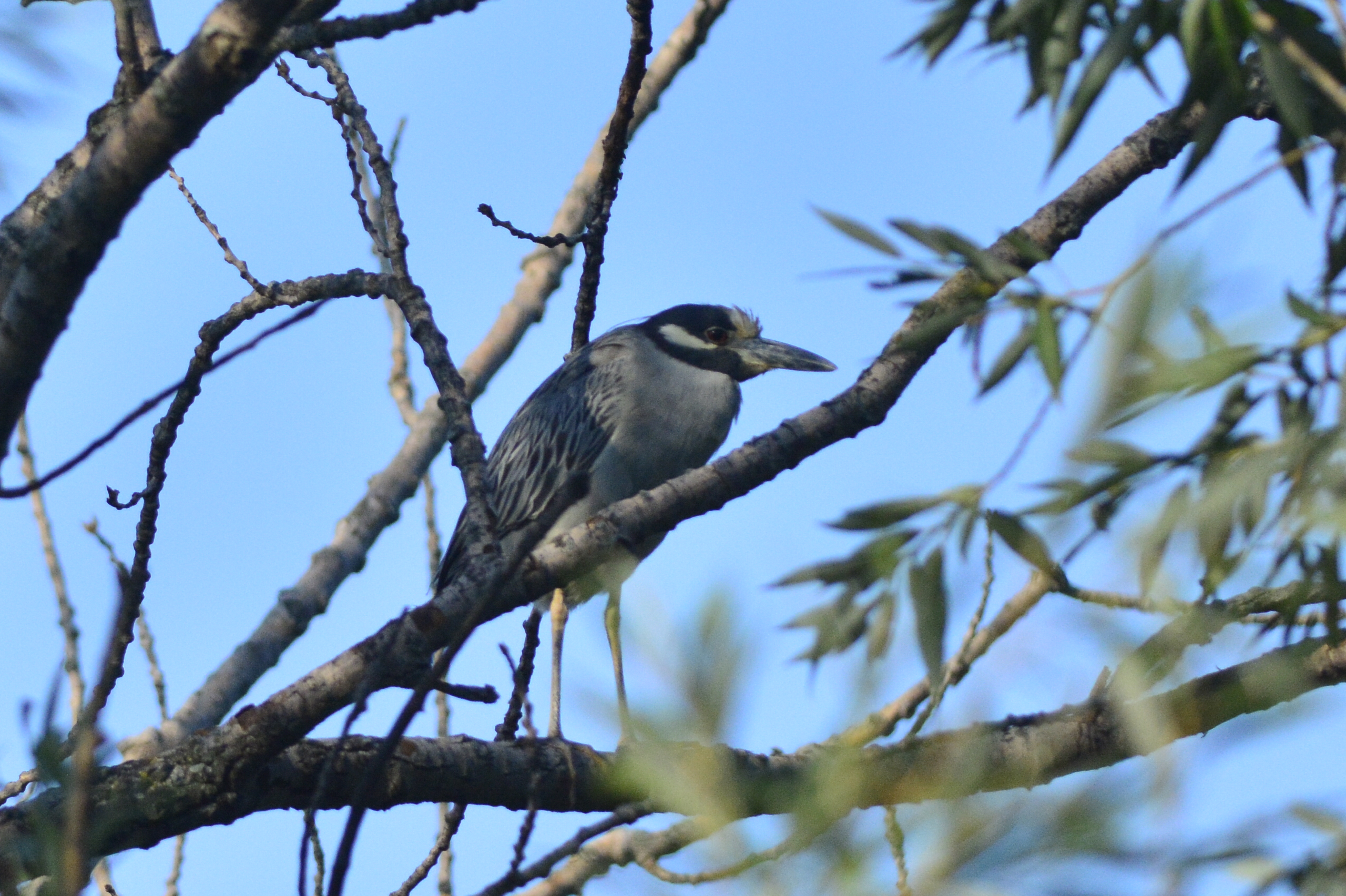
Yellow-crowned Night-Heron Chase


  On July 4th an adult Yellow-crowned Night-Heron was found at LaSalle Park in Burlington by Lori Whibbs. It was seen roosting in the morning, then continued being seen by numerous birders until the evening, when it flushed and disappeared down the lakeshore. Unfortunately I was working all day and wasn't able to chase it. I was debating going the following weekend when I had some time off, but the Neotopic Cormorant took priority (it was being seen, heron wasn't). 

The heron then vanished for a few weeks, then was found by Alvan Buckley at his local birding patch of Bayfront Park on west side of the Hamilton Harbour. Again I was too busy with work to chase it when it was first seen, but I made plans to do a quick search before I left for a birding trip to North Carolina on July 28th (post on that soon). I walked the entire area around Bayfront searching, along with Alvan and Luke Raso, but ultimately came up empty.

Then after nothing again for a few weeks, Alvan refound the bird roosting along a footpath at Bayfront Park. This time it was seen consistently throughout the day, so when I finished work at 4pm I booked it down to Hamilton. Richard Poort and a few other locals were keeping tabs on the bird for me, texting me updates to let me it was still there. I was half an hour out and got a message saying "It has turned around and opened its eyes"... I will not lie that was slightly concerning! I wheeled into the parking lot at Bayfront after hitting what seemed to be every red light in Hamilton, then full out sprinted to the end of the park where the bird had been seen. Alvan and another birder who I only know as Paul were waiting there, and sure enough the heron was still roosting in its tree! Oh sweet success. This was a lifer for me too, another bird I have had plenty of chances to chase in the past and haven't... so kinda overdue. 

- Yellow-crowned Night-Heron


Yellow-crowned Night-Heron is still an OBRC review species for Ontario, although with sightings on the rise I doubt it will be for many more years. Besides the Hamilton/Burlington bird (or two birds possibly) there were also reports in Niagara and Cornwall this year. I didn't chase either one of these, as the Niagara one was seen by one person and never seen again... and the Cornwall one was when I was in Pelee and it was 8 hours away & needed a canoe to access... so wasn't that enticing. So after missing it once before in Hamilton, it was a relief to get it.


In other news I got lucky and saw a King Rail recently, but I can't say where/when right now due to how sensitive they are. With the heron, this brings me up to 335 species... only 11 shy of the record now! 

- King Rail


Ontario yearlist @ August 10 - 335


Panama Trip - Part 1

Just after midnight on the morning of February 22nd (I couldn't really sleep due to preflight jitters/trip excitement, so to me it was s...