Calendar Ad


 Hey everyone!


I’ve decided to sell calendars for the first time this year, and I’m advertising early so people could get some in time for Christmas if they want. I posted this on social media and figured I may as well throw it on the blog as well.

I’m still working out which photos I’ll be using, but below are some of my favourites from the last two years as samples… note that not all will appear in the calendar, definitely some of them, plus shots of similar quality.


I’ll be printing two sizes of hangable wall calendars:


Small (11.5”x8”) - $28

Large (17”x11”) - $35


Both prices include shipping in Canada 


Email me at kiahjasper@gmail.com to order ✌️


Bruce Birding Oct 4th -10th


 Another quick update on some recent "50 days of rare" birding fun


- Oct 4

Alessandra and I decided to spend the morning working the Ferndale Flats area, with hopes of turning up a cool sparrow or longspur. Migration was fairly slow, although there were lots of American Pipits, Lapland Longspurs and Eastern Meadowlarks around. After covering most of the eastern Ferndale area we headed over to Lion's Head and birded around the harbour area... All the usual suspects plus first of fall Surf Scoter. Tons of pipits around the Mar area on the way home, but overall a pretty uneventful day.

- American Pipit

- Horned Lark

- Pipit


- Oct 5


The winds were quite low during the morning, so we drove over to Oliphant to bird the shoreline for a few hours (low winds make Nelson's Sparrow hunting easier, plus there's more visible shoreline). The north flats area had a few groups of Black-bellied Plovers, plus yellowlegs and 8 late Semipalmated Plovers... Basically the same stuff that's been in the area for a few days. A thorough walk around the grasses and shoreline of the Oliphant Fen area produced 0 Nelson's or LeConte's Sparrow, but there were a few cool birds to keep things interesting... 12 American Golden-Plover, 9 Pectoral Sandpipers, lots of dabbling ducks and a longspur. On the way home we stopped by Sauble River mouth, where there were basically no birds to speak of! It was midday at that point so we headed home for the day.. No other highlights.


- Oct 6

Conditions looked decent for lakewatching around south Bruce, so Alessandra and I got up early and drove down to Kincardine for a watch at Dunsmoor Park. On the way out the door we heard several Gray-cheeked Thrushes flying overhead, my first of year for Bruce. Arriving at Dunsmoor just after dawn, we spent the next several hours watching waterfowl and gulls migrating by. It wasn't the best day I've had there, but honestly not terrible for the date! Highlights listed below;

- 39 American Wigeon

- 12 Northern Pintail

- 61 Redhead

- 3 Greater Scaup (first of fall)

- 12 Lesser Scaup

- 12 Surf Scoter

- 2 Red-necked Grebes

- 4 Black-bellied Plovers

- 1 Common Tern (late)

- 1 Forster's Tern (not annual in Bruce... around 18 records all time. My 2nd for the county, and also this location!)

- 16 Common Loon

- 1 Peregrine Falcon

- 1 Swainson's Thrush (watched it come in from wayyy out over the lake)

- Forster's Tern

- Peregrine Falcon

- Semipalmated Plover

- Surf Scoters

- Swainson's Thrush fleeing the lake


Checked a few spots on the way home, but no real highlights to speak of. 2nd yard record of Green Heron calling after dusk was cool though.


- Oct 7

Considered another lakewatch, but the following day looked a lot more promising/I was tired, so we birded locally around Oliphant. Several Black-bellied and Semi Plovers, a lone golden-plover and some Dunlin were the only shorebirds around, and a juv Peregrine Falcon with a full crop whipped by... maybe not encouraging many shorebirds to stick around the area. Heavy peregrine migration all along the coast that day, with a highcount of 30 new Grand Bend. We tried the Sauble Beach waterfront after that, where we had 3 more peregrines, some scaup and a rather unexpected bird... a Yellow-billed Cuckoo flying by the sand dunes. Caught me off guard at first! My latest record for the county by weeks and only our 3rd October record... pretty cool. 

We cut inland after that, checking the Wiarton harbour and sewage lagoons. Again pretty slim pickings, only highlight was a lone Ruddy Duck.

- vismig Yellow-billed Cuckoo

- Yellow-billed Cuckoo, when it briefly landed


- Peregrine Falcon with full crop

- a very buffy juv American Golden-Plover

- Pectoral Sandpipers

- Oct 8

Originally this day was looking a lot more promising, with wind gusts forecasted near 100kph from the northwest, giving me high hopes of another Bruce jaeger day. Unfortunately the winds got lighter as the day approached, and what we got turned out to be around 50kph with gusts of 75, the direction also shifted, from northwest more to straight north. I still drove down to Kincardine to try it out, arriving with Alessandra shortly after 7:30. Erik (aka Boomer) drove down to join us as well, staying for the majority of the day. Several others came and went, though the bands of near horizontal rain scared off most sane birders. The reason I like Dunsmoor so much is because there's a nice sheltered viewing area under a pavilion, so you can still scope while staying dry and avoiding the worst of the rain on nasty days. Shortly after arriving massive numbers of Ring-billed Gulls started streaming over... nearly 2000 in under half an hour. The duck migration was also fantastic, some of the best I've had in Bruce during early October. The Sabine's Gull/Jaeger numbers were less fantastic on the other hand, with a grand total of 0... We ended up leaving around 2:30, so a solid 7 hours of lakewatching. No crazy highlights, but it was a really fun day of watching/chatting with friends! Quinten did a great blog post comparing what all the birders out along Huron saw, read that HERE.

 Here's the eBird list for full numbers, but here are some highlights;

- 40 Green-winged Teal

- 60 Scaup (40 Greater, 20 Lesser)

- 181 Surf Scoter (New Bruce highcount.. old one was 41!!)

- 118 White-winged Scoter

- 1 Black Scoter (first of fall)

- 1 Long-tailed Duck (first of fall, early)

- 240 Common Merganser

- 1 Red-necked Grebe

- 1 Sanderling

- 81 Dunlin

- 1 Lesser Black-backed Gull (surprisingly rare in Bruce. I see 1-3 a year)

- 2 Common Loon (way less than Friday.

- Surf Scoters

- Lesser Black-backed Gull

- More Surfs

- Dunlin

- Surf every other photo


- Oct 9

Heavy rain and west wind for the majority of the day. I still got out to check a few spots, but didn't spend very long. The highlight of Petrel Point/Spry Lake/Wiarton Lagoons was Trumpeter Swan and some scoters... so yeahhhh


- Oct 10

In the morning Alessandra and I drove over to Petrel Point for a lakewatch, conditions weren't great but I don't lakewatch locally nearly as much as I should so I wanted to give it a try. After half an hour of being there a band of rain came in and we bailed, but before that we had a few peregrines and a Surf Scoter, the latter being a new bird for my 5MR (so sad....). We noticed there were a ton of sparrows along the roadside between my place and Petrel, so we spent the rest of the morning hunting for rare sparrows between Red Bay and Stokes Bay. I was really feeling optimistic about a Harris's, or really any rare sparrow considering the massive numbers... Wasn't meant to be though. By the time we returned hope we'd seen well over 1200 sparrows, with the bulk being White-crowned (700) and Dark-eyed Junco (350). Shortly after returning home I saw a report of a Harris's Sparrow from MacGregor in South Bruce the day before... of course.

Rest of the day was spent contemplating life


- Oct 11

Spent most of the day driving down to Pelee for a big year presentation in Windsor, so I wasn't able to bird very much (mainly due to leaving too late). I did bird a lot on the 12th/13th though, which I'll cover in my next post. 

Early October Rarity Hunting at Oliphant


Follow-up to my previous post about 50 Days of Rare... This one just covering how I've started off the challenge.


One of my goals this month is to get out birding as much as I can, particularly at spots that have high potential for rarities. For the past few weeks the weather has been quite boring in terms of "rarity weather"... High pressure just holding over northeastern North America and giving us hot, sunny weather with mainly poor winds. So not exactly inspiring conditions to go rarity hunting. Promising weather is coming down the pipe though, and by the weekend there should be some interesting birding to do. Anyways, I decided to keep things local until then and bird the Lake Huron shoreline hard, mainly between my place and Sauble Beach. This area has some great birds around this time of year in the past, most notably Michael Butler's Ontario first Eurasian Dotterel... so the potential is definitively there for something cool. The water levels have dropped significantly at Oliphant this season, which has created lots of promising habitat (large mudflats/exposed shorelines). This is something I've been waiting for for years, so I'm thrilled that I'm able to be home this fall to see it. 


- October 1

Alessandra and I drove to Oliphant at sunrise and met up with Alfred Raab to scour the "North Flats" area. The morning was nice and sunny with basically no wind at all, which was kind of cool since we could hear birds calling way out on the islands (over a kilometer away). Lots of pipits/siskins flying overhead, as well as some Lapland Longspurs and "Yumps" kept things interesting. Right off the bat we came across a large flock of shorebirds containing 6 species, most notably 12 American Golden-plovers, 1 White-rumped Sandpiper and 9 Semipalmated Sandpipers (getting late for them). For a local birder this was quite exciting, as it was the largest flock of shorebirds/best diversity I had ever seen there. Pretty pumped to see what happens there this season! After that we scoured the fen area for songbirds, and Alessandra got on a Nelson's Sparrow, the 6th record for Bruce on eBird... not a bad way to start off the month! No major highlights after that, 2 more American Golden-plovers were cool though! By the time we finished off there it was midday, so we headed back home for the day.

- American Golden-plover

- Semi Plovers

- Nelson's Sparrow


Nothing else too noteworthy besides a patch rarity... House Sparrow.


- October 2

Birded the yard for an hour at sunrise... ended up with 32 species so not too productive... But there were a few highlights including yard lifer Blue-winged Teal, 2 Northern Shovelers (3rd yard record) and a decent passage of Yellow-rumped Warblers (53).

- Yellow-bellied Sapsucker

- Blue-winged Teal

- Yump


After that Alessandra and I drove over to Oliphant and combed most of the shoreline. It was fairly quiet compared to the previous day, highlights being 1 American Golden-plover and 17 Semipalmated Sandpipers. There was a dog walker at the good spot where we had a lot of luck the previous day, so that hurt our shorb count I'm sure. From there we headed down to Sauble Beach, where we spent a bit of time scanning the beach and river mouth. Again not too much, save for some Bonaparte's Gulls. On our way back towards home we checked some field habitat (nothing) and the Wiarton Sewage Lagoons (a few Redhead). We had stuff to do for the rest of the day so no more birding.


- October 3

Arrived at the Oliphant shoreline just after sunrise and started scouring the fen area for sparrows and shorebirds. Nothing on the sparrow front, but the plovers put on a decent showing with 8 Black-bellied, 6 American Golden and 13 Semipalmated. A few other random things but nothing noteworthy...

Once we were done at Oliphant we drove north along the shoreline, stopping briefly at a few spots before visiting Petrel Point to look at the perfect Scissor-tailed Flycatcher habitat (fun fact, this spot has  Fulvus Whistling-Duck record). Petrel was very dead, not even a single Black-capped Petrel flying by... annoying...

It was really heating up at that point so we headed home for the day to get some chores/computer work done. It may hurt my chances of finding birds, but I hate birding midday on hot sunny days, it just kills my enthusiasm/drive... Would I go out in gale force winds and driving rain? You know it. A hot, cloudless day with no wind? Forget it.


Anyways that's what I've done so far this month, 78 species so far for October. More posts to come in the near future

50 Days of Rare... revamped!


A shorter post this time around, I figured I would share an update about what I've been up to!


After finishing up a work contract with Birds Canada in mid August, Alessandra and I headed off on a 35 day journey exploring western Canada. We saw so many cool places and I got lots of lifers... But I want to save that for several longer posts to give it the justice it deserves... should get to that soon : )


We arrived back in Ontario just in time for the annual OFO convention in Peterborough, driving straight there from Sault St. Marie. Alessandra had to do emceeing on Saturday night (killed it of course) and I introduced my new bird of the year program. We did some birding with William Konze, seeing over 90 species and scoring a lot of county ticks in the area. Fun times...


Once we got back home on the peninsula, we rested up for a few days and took a much needed break after living in my chevy cobalt for such a long time. I spent a few days birding around the yard, which turned out to be surprisingly productive... highlights include yard lifer Blue-winged Teal, nearly 500 morning flight Yellow-rumped Warblers and some other fun things. My best list of the week linked here. As October started to draw near I started getting really hyped up for rarity season, and my favourite month of the year to bird. One thing that has bugged me slightly over the last number of year of birding has been the lack of rare birds I've found during the month of October. It's arguably the best time of the year to find good birds in the province, but the list I have of rarities to show for my effort is relatively low.

 After giving it some thought, the main issue that's been hurting my chances is kind of funny... I like fun birding too much. Previous to 2022, I mainly birded my yard/local patch during the fall, focusing on morning flight and hawkwatching. Both of those forms of  birding are very enjoyable to me, but the rarity yield is quite low. Hawkwatching in general has low yield in Ontario, maybe a Swainson's Hawk or Black Vulture if you put in enough effort, but other than that it would have to be something pretty mega. As far as vismig goes, there's definitely potential there for rarities there, but the type of stuff I get here turns up rarities quite infrequently (that could be a whole other post). I definitively don't want to give the impression that I'm complaining, I'm not! Sometimes rarities just aren't the vibe, and I find it just as enjoyable seeing large numbers of migrants pass through in a morning. 


Anyway, I want to try and do things a bit differently this fall. My goal is to try and find rarities, and bird as frequently as I can and see what happens! Because the more you're out looking in productive areas, the more you'll find. After I decided to do this, I was trying to come up with ways to motivate myself and get others on board for some hardcore rarity hunting... Then I remembered reading something awhile back on Brandon Holden's blog, a challenge that he ran with some friends called "50 days of rare". If you want to check out that post click Here, but to sum it up the idea was to motivate birders around the Great Lakes region to get out and search hardcore for vagrants and blog about it. Basically right what I was going for! I then decided that I would try restarting this challenge, with a few tweaks and changes of my own (mine starts on Oct 1. instead on late September, mainly because I had the idea a bit late). I drafted up a post and then threw it up on some of the provincial birding servers... That post below..

" Here’s how I’m going to do it. Since it’s later than mid September, I we will do it from today (October 1) until November 20th. Birds you saw today can count. Rules and information can be found below… 

1. The bird has to be self found (check out Punk Birders Self Found rules. Posted on the Facebook group I made).

2. The bird has to be in Ontario during the dates I mentioned above.

3. The winner of our friendly competition will be determined by who finds the rarest bird (rare is a bit subjective, but it will default to the rarest at a provincial level. More discussion in the group).

4. Unlike Brandon’s version you don’t have to have a blog to participate. The aspect of telling people your birding plans is kind of fun though! So we can still do some of that if people are interested.

5. The winner will receive bragging rights… and a free T-shirt, with artwork of their winning rarity done by Alessandra Wilcox 🙂

The idea is to have some fun/see what other people are finding in the province and have some motivation to get out birding a lot during peak rarity season. I’ve made a Facebook group where people who can join can post their finds/discuss (that way the server won’t get cluttered). So to sign up like this message and I’ll message you information on how to join the group

Here’s the link (everyone who asks to join will be accepted).

https://m.facebook.com/groups/3640031096241766/?ref=share&mibextid=S66gvF "


So there you have it! So far 35 people have joined and some folks seem hyped up... I'm excited to see what's found! A few people (coughHoldencough) were a bit hesitant to join up at first, but came around after they discovered a T-shirt was on the line. Maybe if this is popular we can get a plaque or something, but I think it would be fun if it became an annual thing. It really isn't about prizes though, but having some community motivation and comradery to get out there and find cool birds. If you want to join then just click the link above!

I'll try to post here a fair amount this month about the progress, so stay tuned!


Here's a Swainson's Hawk photo from out west to end off the post 


Pacific Golden-Plovers in Ontario


I found this post that I started back in 2020 and thought I would edit and repost now!

I've done a lot of research over the winter about birds that Ontario needs for it's all time list and I keep coming back to a few species. One of these species is PAPL, which has occurred numerous times along the eastern seaboard, yet somehow manages to avoid Ontario.. so I'm going to do an atypical blog post and really get into the vagrancy/ID of Pacific.

Ok so let's start with the basics. According to eBird, there are 8 records in the Northeastern US and 7 in eastern Canada as of November 2020.
The dates are as follows; 04-21 (MA), 05-12 (NL), 05-20 (NL), 06-05 (NL), 06-26 (NL), 07-16 (NL), 07-25 (DE), 07-25 (MA), 07-30 (NL), 09-01 (NY), 09-04 (NJ), 09-06 (VT) (iffy..), 09-11 (ME), 09-14 (NL), 12-06 (NL).

Since writing this there have been at least 5 more... 04-23 (NS), 09-25 (MA), 08-26 (MA), 10-29 (CT), 09-16 (PA), 05-16 (NJ) Which makes it even more frustrating that Ontario hasn't had one....

2020

 2023


There is a trend of birds showing up during June and August, with a few records in April, May and December. The December record is a wacky one from Newfoundland, though there are others from Florida in the winter (more expected there though). July/August seems like the most likely time for an Ontario sighting to me... and to make things a bit easier there aren't a ton of AMGP around then either. 

It's been suggested that the east coast birds are mirror image orienting, meaning they migrate 80-160° in the wrong direction. As you can see above, almost all of the records are close to the Atlanta. This could be because the plovers book it across the continent and stop only when they hit the ocean? Or maybe just due to the lack of good habitat. A lot of shorebirds will fuel up on breeding grounds, then migrate a very long distance before setting down again (why Ontario gets very low numbers of almost all shorebird species, they fly over but just don't land). Some of the PAGP that breed in Alaska migrate 2000km nonstop to wintering grounds on islands in the Pacific Ocean, so the eastern records make sense if you picture the map flipping and the birds heading east instead. Anyway with all of our sewage lagoons, farm fields and Great Lake shorelines, we should have more of a chance to get a PAGP than some of the surrounding states. Unlike AMGP that are often see in fields and areas lacking any water, Pacifics seem to prefer to forage along shorelines and in wet areas.


    -Identification.

Ideally we could get a definitive alternate (breeding plumage) male in prime light, with an AMGP right beside it for good comparison. This is unlikely to happen though and we will likely get a or a juvenile or ratty adult in prebasic plumage. After a lot of reading on the subject, I've narrowed it down to a few useful field marks.

1) Primary/Tertial ratio 
 - On the folded wing of a Pacific Golden-plover (PAGP) 2-3 primaries usually extend beyond the longest tertial, while on American (AMGP) 4-5 primaries are usually visible. I say "usually" because molt and viewing conditions can make this hard to judge. Americans have relativity short tertials and long primaries, while Pacifics have long tertials and shorter primaries. This sounds like it should be pretty reliable and, while it's a good feature at time, it may also be one of the most problematic. Almost any plover can be molting it's tertials and primaries, which means that the ratio could be thrown off/fit the wrong species. It can work well as a supporting feature though, and may be helpful in the final identification.

2) Primary projection past tail
- On a similar note, the primaries usually do not extend past the tail on PAGP, whereas they normally extend past the tail on AMGP (or are at least even with it)... extension being 0-9mm in PAGP and 12-22mm in AMGP. The long wings of American often gives the tail a scissor-like vibe.


3) Toes
- This is an iffy field mark, but I thought I'd mention it. On a flying Pacific, the toes *should* extend past the tail, where they fall short on an American. Looking at photos it seems to work sometimes.. but can be quite deceiving depending on angle/what the bird is doing. Having flight shots never hurts though!


4) White line on flanks/side of breast
- For use on adult alternate/Prebasic plumaged birds. On PAGP, there is a continuous white line from the head to the tail.  On AMGP the white ends abruptly at the flanks, which are totally black. Female Pacifics have a less defined breast than males and the breast can be covered in white splotchy areas. Males have a solid black breast with a well defined white line along the side.

5) Tibia
- on Pacific, the tibia (upper leg) usually isn't feathered as heavily as American, which gives it a long-legged appearance. PAGP tends to have a longer tarsus than American, with the tibia more exposed and less feathered proximally, giving it a somewhat longer-legged appearance than AMGP. This is true in all plumages.

6) Bill
- The bill on PAGP is almost always longer and thicker than that of American, which appears more obviously when the birds are side by side. Looking through photos this seems to hold up quite well!


7) Golden Speckling/Overall Vibe
Adult Pacific's tend to have more, and larger golden spots on their back than American's do, and while in preformative molt there often seems to be a lot of messy white splotching throughout (not really seen on AGPL). In Prebasic plumage, PAGP often show a more buffy face as well. As for the impression the bird gives, or the "vibe", this is tough for me to write about as I've never seen one in real life. Reading accounts from other people/looking at photos and videos, PAGP usually have lankier and taller impression than AGPL, with a rounder head. I'll update this when I see some in the future : )

Let's have a look at bird pictured below. It's a fairly bright and well defined plover in definitive alternate plumage, with a white line extending unbroken from the head to the undertail coverts. Three primaries are visible past the longest tertial and the primary projection seems to be pretty short (tough to judge from one shot sometimes though).

- Pacific Golden-Plover 
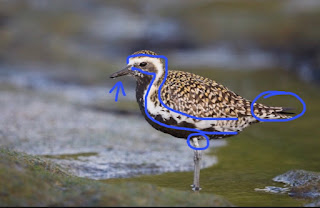
        Things to note:
  • short primary extension past tail/long tertials
  • white along flanks
  • long tibia due to lack of feathering
  • large, thick bill


(Quick sidenote. I used pictures from the Macaulay Library for this post, however the resolution will appear poor because they are screenshots. To see the full quality images/photographer info, click the links below the photos.
 

Now this adult American. It's a pretty straight forward ID as far as plovers go... white ending sharply above the beast, all dark flanks and undertail coverts, 5 primaries visible past the longest tertial. Primaries extend beyond tail, short tibia due to feathering.
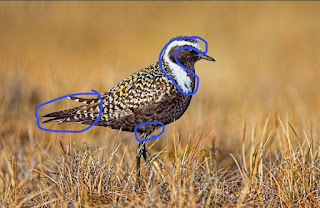
- American Golden-Plover
(https://macaulaylibrary.org/asset/64786971)

         Things to note -
  • long primary extension past tail/short tertials
  • white limited to upperparts, dark flanks/undertail
  • lots of feathers around tibia
  • Shorter, thinner bill


  Juvenile birds

- Juvenile Pacifics usually appear buffy golden overall, where American is more gray and dull in comparison. This seems to hold up among most juveniles, though it becomes increasingly less obvious into late fall, when the feathers become worn and more grey. Juveniles gain their first plumage on breeding grounds in the tundra, then begin a preformative molt once they reach their wintering range. Juvenile plumage is mainly visible July through October, though sometimes all the way into November. PAGP also lack the very prominent white supercilium shown by AMGP, instead showing a golden wash through the supercilium and face. This golden yellow look gives pacific a very warm and buffy appearance. Most birds lack vibrant golden tones by November, though some is retained on the head and scapulars.

 - The primary formula mentioned for adults (3 Ps visible past longest tertial) can still be used on juvenile birds, although molt effects this heavily. This is somewhere where APGL differs from PAGP, as American is the only Pluvialis plover that includes all of it's primaries during preformative molt in the fall... Which could potentially create confusion and give a bird a "shorter winged" look. Keep in mind that most Americans molt later when they reach wintering grounds, however preformative molt could start as early as mid/late October. Because of this difference in molt timing, it stands to reason that in the spring birds with fresh primaries should be AMGP, while birds with old primaries should be PAGP (which don't molt flight feathers until after their first summer). There can definitely be tricky birds during this time, so careful documentation is required. 

- Something else I found while researching different articles/videos was that juvenile Pacific head shape differs from that of American. The head of an American looks more capped and squared off than that of a Pacific, also American often has a thinner nape line. I went through a lot of photos on Macaulay Library, and this does hold up quite well. There are Pacifics that appear capped, but if you look at that, the bill, and the buffiness of the face together, it's often quite reliable!


Ok, with all that said, lets have a look at some photos! 

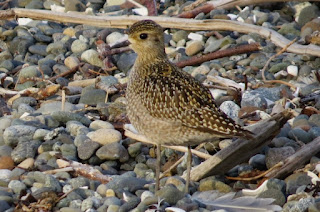
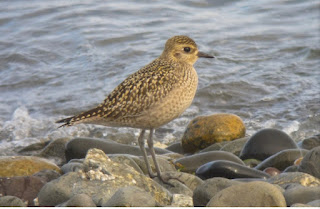
First up is this juvenile bird from Washington, US. It is very buffy overall, with an off-white, sort of golden supercilium. It also shows a long bill, long tertials (3 primaries visible past tertials) and the primary projection past the tail is quite short. Additionally, the cap isn't that dark/prominent and there isn't much coarse streaking. All told a pretty solid pacific!
- Juvenile Pacific Golden-Plover
                                                https://macaulaylibrary.org/asset/68994211


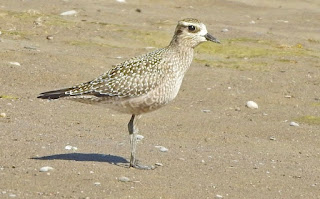
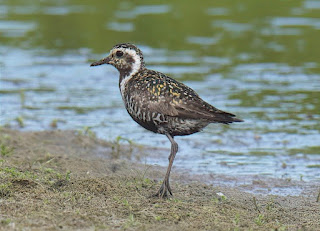
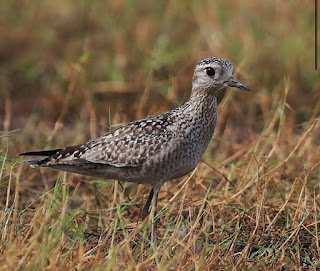
For comparison, here's a photo of a juvenile bird from here in Ontario. Compared to the PAGP above, it is very grey overall, with a bold white supercilium and a shorter bill. The face is very stark grey and white, lacking the buffy golden tones. Similarly the rest of the bird's plumage is very grey overall, as seems to be the case with a lot of young AMGP. The long primaries are clearly visible, with 4 projecting past the tertials and going well past the tail.
- Juvenile American Golden-Plover
                                               https://macaulaylibrary.org/asset/176382611


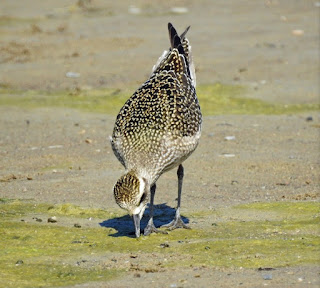
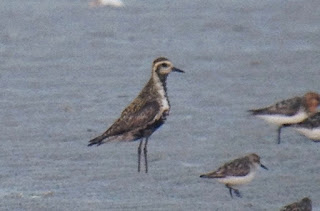
Here's an AMGP from Toronto, clearly showing a long primary projection/extension past tertials, a white supercilium and a strong capped look to the head (dark crown contrasting strongly with nape).
- Juvenile American Golden-Plover
                                               https://macaulaylibrary.org/asset/176385361


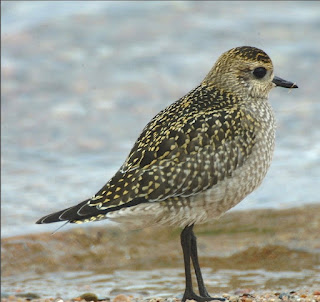
This photo from Alberta shows an AMGP that is quite buffy overall, with a fairly nondescript supercilium and a pretty golden speckled back. Note the strongly marked, dark cap, short bill and long primary extension past tertials. Also, even though the face is quite dark and messy overall, it still has more of a "cold" grey look to it.
- Juvenile American Golden-Plover
                                                   https://macaulaylibrary.org/asset/92559831

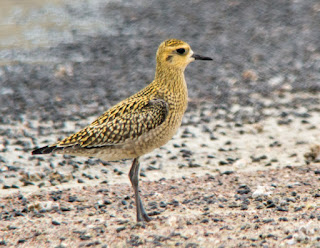
To show an extreme side of things, check out this juv PAGP from Alaska. This birds entire body is very golden, from it's head all the way down to it's face. Hardly any white or grey visible in the face, just a yellowish wash. Short primary extension past tertials also visible. This bird does have a bit of a capped appearance, though it's not as stark/obvious as it is in most AMGP.
- Juvenile Pacific Golden-Plover
                                                https://macaulaylibrary.org/asset/39406811


Next up is this adult bird, one of the East Coast from North Carolina. It was taken in August and the bird is clearly in the middle of heavy molt, with some of the body feathers, scapulars and tertials appearing very worn and ratty. It's tough to use the primary/tertial ratio on this bird, though the primaries still appear to not project very far past the tail. This bird clearly has a very large bill, and there is white visible all along the edge of the flanks/undertail coverts. Limited feathering visible on the tibia as well. 
- Adult Pacific Golden-Plover in prebasic molt
                                                 https://macaulaylibrary.org/asset/468421261

Most of the Eastern records are either adults in July and August, or juveniles later in the season. The adults tend to be quite worn and messy, though most aren't that big of an ID challenge if you know what to look for. Here's another adult, this one from Massachusetts in late July. Face very white with large bill... lots of white on the flanks/undertail coverts, very large golden speckling on the back, short primary projection past the tail. If you click the eBird list after viewing the photo, the finder has some thorough comments about the sighting which are cool to read!
- Another ad prebasic Pacific
                                               https://macaulaylibrary.org/asset/35586901


Something interesting I found while going through photos... the old world PAGP appear a lot more golden in juvenile plumage. Like this bird for example..
- Juvenile Pacific Golden-Plover (Hong Kong)
                                               https://macaulaylibrary.orHg/asset/117240631

Another interesting thing to note.. especially later in the season (Nov/Dec), some juveniles are quite worn and seem to totally lose their golden colouration.. like this bird..
- Juvenile Pacific Golden-Plover in December
                                                https://macaulaylibrary.org/asset/124200061.


It's worth noting that I didn't discuss adult birds in full basic plumage at length. This is the most unlikely plumage to show up in Ontario, so I mainly focused on the ones that pertain to the majority of the Eastern ABA records (juvs and summer/early fall adults). Identifying an adult in basic isn't too much different from a juvenile bird though, as most of the field marks mentioned will still hold up! There is also the possibility of a 1st/2nd alternate showing up during the spring, but again I wanted to keep this fairly short and focus on the most likely plumages.


- Conclusion

I have a few takeaways from searching through a lot of Golden-Plover photos are articles. The main one is that most features are variable, and if you're trying to identify a bird based entirely on one thing it may result in misidentifications: for example, assuming a very dull grey bird is always an American, or relying on the primary ratio and not taking molt into consideration). A few ID marks hold up quite well... I found the very stark, "capped off" look of juvenile American Golden-Plovers is found on almost all birds, though sometimes Pacifics can show a bit of a cap too. It can definitely be a starting point though, like any of the ID marks mentioned above. The primary extension/primary to tertial ratio is also very helpful, though not without it's faults (molt, viewing conditions). If all the features start lining up though, it's likely that you have a bird worth investigating further! Americans that are very buffy/golden usually will display at least one or two characteristics of it's species, while the same can be said for a dull pacific with a smaller bill.

 Study a bird that seems even a bit "off"... look very closely at the entire bird, and try to take good notes describing everything you see/document it well with photographs. Careful observation of any Golden-Plover you come across will be helpful, as once a good familiarity is established with Americans it will be a lot easier to notice when something looks different. Some distant birds simply aren't IDable too... and it's ok to leave a bird as a "sp" sometimes...


Hopefully this post makes the idea of finding and identifying a PAGP a bit less daunting! These are just my thoughts from doing a bit of research, and are by no means a definitive identification guide. I may add a quiz on this subject soon, or add more photos/comparion pics if people are interested!


References; Birds of the World (2023), Johnson O.W., and P.M. Johnson (2004), Kauffman K (2000), BirdGuides website (2010), M. Reid (2011)

Panama Trip - Part 1

Just after midnight on the morning of February 22nd (I couldn't really sleep due to preflight jitters/trip excitement, so to me it was s...